200, 300 or 500 hours: what the numbers mean
Yoga teacher training is sold in hours, and the hours follow the tiers of Yoga Alliance, the registry that schools all over the world advertise against. Its directory describes a 200-hour school as foundational training for new teachers, a 300-hour school as advanced training that builds on that foundation, and a 500-hour school as one whose programme meets both standards in a single, longer course.
So the levels are a sequence, not a menu. The 200-hour course is where almost everyone starts, however long they've practised: it covers technique, anatomy, philosophy and the mechanics of teaching a class. A 300-hour course assumes you've done that and goes further into sequencing, adjustment and the texts. Yoga Alliance's own guide to training options describes two ways to reach 500 hours: all of them at one school registered for 500 hours, or a 200-hour course followed later by a 300-hour course at a school registered for that level.
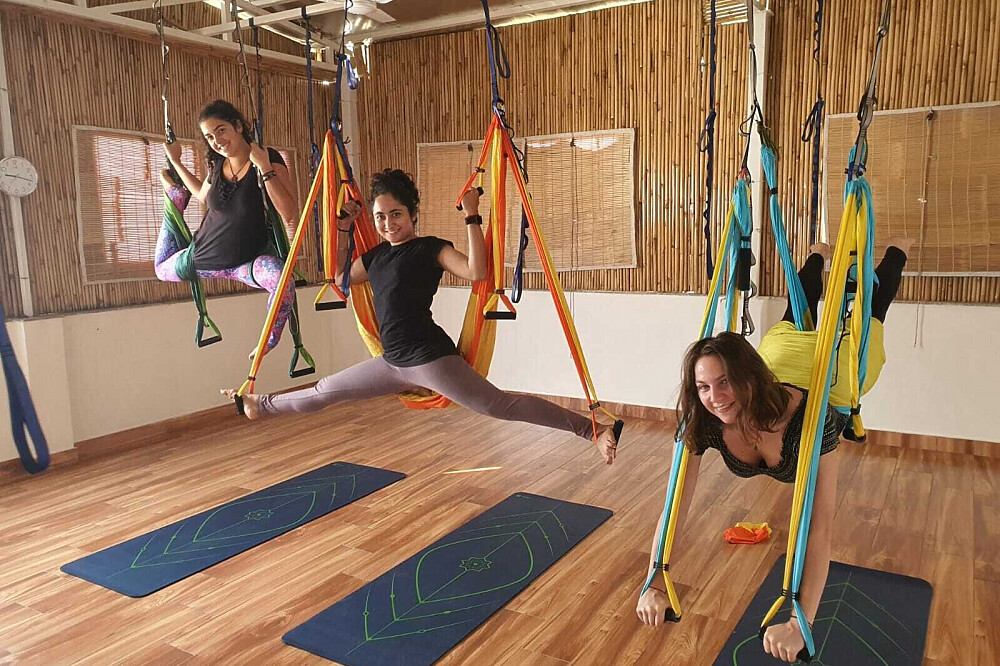
Courses under 200 hours are a different thing again. Fifty and hundred-hour trainings in yin, prenatal, aerial yoga or yoga nidra are specialist courses, built on top of a foundation rather than instead of one. They suit teachers adding a method and practitioners who want to go deep on one style. A short course that promises to make you a fully rounded teacher is claiming more than its hours can hold.
The table shows how the programmes in this guide divide by level: how long each level runs, what schools charge for it, and where it's taught.
| Level | Programmes | Length | From-price (US$) | Where |
|---|---|---|---|---|
| Under 200 hours | 12 | 5–15 days | US$225 – US$1,904 | India, Indonesia, Greece, Guatemala, Italy, Nepal, Sri Lanka |
| 200 hours | 20 | 20–26 days | US$360 – US$4,000 | India, Indonesia, Colombia, Costa Rica, Guatemala, Italy, Nepal, Portugal, Thailand |
| 300 hours | 8 | 27–31 days | US$380 – US$3,230 | India, Italy |
| 500 hours | 1 | 40 days | US$500 | India |
What registration tells you, and what it doesn't
Yoga Alliance is a US-based nonprofit membership organisation, not a government body, and as Wikipedia reports, it describes its registry as a voluntary credentialing system. It isn't a licence to teach. Whether you need it depends on where you want to teach. Some studios and employers ask for it; others care more about how you teach an audition class. If you're unsure, ask two or three studios where you'd like to work what they look for before you choose a course.
If you do plan to register afterwards, the school's status is what counts. The registry's certificate requirements ask for proof that you trained at a Registered Yoga School, with the school's registered name, the level of training, the completion date and your legal name on the certificate. Search for the school in the public directory before you pay, and check that the school itself holds the level you're buying, not just one of its teachers.
Registration tells you that a curriculum was submitted against a published standard. It doesn't tell you who will be in the room with your group, how big the group is, or how carefully your teaching will be assessed. The summary at the top of this page counts how many programmes mention Yoga Alliance in their own listing: treat a mention as a claim to check in the directory, not as proof.
Registering also costs money after the course. The same training guide lists a one-time application fee of US$50 and an annual membership fee of US$65 for teachers, separate from anything you pay the school.
Intensive, spread out, or partly online
The classic format is the residential intensive: you move in, and the course is your whole life for three or four weeks. Two hundred hours in that time makes for long days, and Yoga Alliance's policy on hours per day caps registered schools at 14 hours of instruction a day, which gives a sense of how full a compressed timetable is allowed to get. Divide a course's hours by its days and you'll see what it asks of you.
Intensives suit people who can take a month away and learn best by immersion. They're hard on the body, and they leave little time to absorb one session before the next begins. Part-time courses spread the same hours over several months, often at a studio near home; they're slower, but you can teach real classes between modules and bring your questions back. If you have a job and a life you can't step out of, a part-time course may teach you more.
Online and hybrid courses are now an accepted route as well. Yoga Alliance allowed fully online training as a temporary measure in 2020 and, according to the same summary, made it a permanent option under its 2023 digital standards. A hybrid course, with theory studied at home and the practical work done in person, shortens the time away. Ask how the online part is taught, live or recorded, and how your teaching is observed and assessed.
Style, lineage and the people in the room
Choose the style you want to teach before you choose the country. A Hatha or multi-style course gives a broad base and suits most first trainings. Ashtanga and Vinyasa courses concentrate on flowing, set or semi-set sequences and ask for a strong daily practice. Yin, restorative and yoga nidra trainings are slower and more anatomical, and most people take them after a foundation course. Kundalini has its own lineage, vocabulary and practices, and a course in it is very different from a general training.
Then find out who teaches. Ask the school for the names of the lead trainers on your dates, how long each has led teacher trainings, and how much of the course they teach themselves rather than handing to assistants. Ask how many trainees share a group. In a small group a trainer can watch every student teach every day; in a large one, you may be one of many.
Finally, ask how you'll be assessed. A good course makes you teach, early and often, and gives you specific feedback: practice teaching to your peers from the first week, and a final practical exam in which you lead a full class. A course that ends with a written test alone is teaching you about yoga, not how to teach it.
Where to train
The country matters less than the school, but it changes the price, the climate and the company. India is where the tradition comes from, and Rishikesh in particular has a dense cluster of schools: plenty of choice, and a wide spread of quality. Our guide to 200-hour training in India compares Rishikesh, Goa and Kerala in detail.
Bali has a large yoga community around Ubud, and some courses there combine yoga with sound healing or bodywork; our guide to yoga retreats in Bali covers the island's areas and seasons. Nepal offers trainings in Kathmandu and Pokhara with the Himalaya close by. Beach towns from Thailand to Portugal, Italy and Central America host courses that feel closer to a holiday. They suit people who want the sea between sessions, as long as the setting doesn't pull too hard against a demanding timetable.
Whatever the country, check the visa. A course that ends in a certificate doesn't fit every tourist visa. India's official e-Visa site, for example, lists short yoga programmes among the purposes of its e-Tourist visa but excludes other short courses that end in a qualifying certificate. Read the current rules for your nationality and ask the school which visa its students travel on.
The table below groups the programmes in this guide by country, with the levels each country offers and the range of from-prices.
| Country | Programmes | Levels (hours) | Length | From-price (US$) |
|---|---|---|---|---|
| India | 23 | under 200, 200, 300, 500 | 7–40 days | US$225 – US$2,655 |
| Indonesia | 5 | under 200, 200 | 13–21 days | US$1,731 – US$4,000 |
| Italy | 3 | under 200, 200, 300 | 10–28 days | US$1,710 – US$3,230 |
| Guatemala | 2 | under 200, 200 | 8–21 days | US$1,550 – US$3,750 |
| Nepal | 2 | under 200, 200 | 7–21 days | US$400 – US$1,400 |
| Colombia | 1 | 200 | 26 days | US$1,500 |
| Costa Rica | 1 | 200 | 26 days | US$2,539 |
| Greece | 1 | under 200 | 11 days | US$1,880 |
| Portugal | 1 | 200 | 21 days | US$3,700 |
| Sri Lanka | 1 | under 200 | 5 days | US$788 |
| Thailand | 1 | 200 | 21 days | US$1,500 |
What it costs, and what the price covers
Schools set their own fees. Yoga Alliance's training guide gives a range for tuition at registered schools of US$1,500 to more than US$5,000; the tables above show what the programmes in this guide charge, as a from-price per person in US dollars. The gap between the cheapest and the dearest course is rarely the teaching alone. Some fees bundle tuition with a bed and all meals; others cover tuition only, with the room as a separate line or a choice of room prices. Line up the same things for each school before you compare them:
- The room: shared or private, the bathroom, hot water, and whether it's at the school or a walk away.
- The food: which meals, on which days, and whether the kitchen can handle an allergy or a special diet.
- The paperwork: the certificate, the name it's issued under, and what happens if illness makes you miss sessions.
- The materials: the manual, any books you'll be asked to buy, and whether a mat and props are provided.
- The extras: airport pickup, excursions, and the terms of the deposit if your plans change.
The summary at the top of this page counts what schools most often list as included, among those that publish an itemised list. Where a school doesn't, ask for one in writing before you pay.
Questions to ask before you pay a deposit
- Is the school registered for the level you're buying, and does the directory name match the name on the certificate?
- Who are the lead trainers on your dates, and how many teacher trainings has each of them led?
- How many trainees are in a group, and how many hours will you spend teaching rather than listening?
- How is your teaching assessed, and what happens if you don't pass?
- What does a typical day look like, and which day is the day off?
- What exactly does the fee include, and what will you pay for on arrival?
- Is the deposit refundable, transferable to later dates, or neither?
- Which visa do students from your country usually travel on?
A good school answers all of these quickly and in writing. Hesitation on the first three is the clearest warning sign you'll get.
After the course
Don't expect to finish a 200-hour course ready to lead a full room of strangers. The course gives you the tools; teaching real people is what turns them into a skill. Start as soon as you can, with friends, colleagues or a free community class, and ask for honest feedback. The habits you build in the first few months matter more than which certificate hangs on the wall.
There's no rule about when to take a 300-hour course. Teaching for a while first shows you what you actually need to learn, which makes a second training far more useful than taking both back to back. When you do go on, choose the next course for the gaps your teaching has shown up, not for the destination.